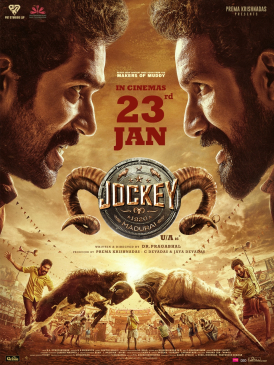
In the rugged terrains of the Madurai belt, where honor is often measured by the grit of its people and the strength of their livestock, Dr. Pragabhal’s Jockey (2026) carves out a visceral, culturally significant space. Moving away from the mud-racing tracks of his debut Muddy (2021), Pragabhal turns his lens toward the “Kida” (goat) fighting tradition—a sport steeped in South Indian heritage but rarely explored with such cinematic ferocity.
Released on January 23, 2026, Jockey is a sprawling action-drama that bridges the gap between a niche animal-sport documentary and a high-stakes rivalry thriller.
Jockey (2026): Movie Overview
| Category | Details |
| Director | Dr. Pragabhal |
| Starring | Yuvan Krishna, Ridhaan Krishnas, Ammu Abhirami |
| Genre | Sports Action Drama |
| Release Date | January 23, 2026 |
| Runtime | 147 Minutes |
| Music | Sakthi Balaji |
| Cinematography | N. S. Uthayakumar |
| Production | PK7 Studios LLP |
Full Plot Synopsis: A Conflict of Horns and Honor
The narrative follows Ramar (Yuvan Krishna), a humble share-auto driver in the Madurai region whose life revolves around his black ram, Kaali. Ramar isn’t just a trainer; he shares a spiritual bond with the animal, treating it as a sibling rather than a tool for profit.
The inciting incident occurs at a prestigious tournament in Usilampatti. Ramar arrives as a distinct underdog, mocked for his modest background, only to face off against Anugundu—the reigning champion ram owned by the arrogant and influential Ghabra Karthi (Ridhaan Krishnas). In a grueling 17-round battle, Kaali defies the odds, breaking one of Anugundu’s horns and securing a decisive victory.
For Ramar, it is a moment of communal pride; for Karthi, it is an intolerable humiliation. The defeat shatters Karthi’s social standing, sparking a vengeful obsession. The film shifts gears from a sports drama into a gritty thriller as Karthi employs underhanded tactics—including sabotaging rematches and threatening Ramar’s family—to reclaim his dominance. When the rivalry leads to the accidental death of a prized animal, the conflict escalates into a cycle of blood and retribution that threatens to consume the entire community.
Detailed Critique: Soil, Sweat, and Spectacle
Themes: The Weight of Tradition
At its core, Jockey is a study of ego disguised as heritage. Pragabhal explores how traditional sports serve as proxies for masculine pride. The film successfully juxtaposes the innocent ferocity of the animals with the calculated malice of their owners. It asks a poignant question: Who is the real beast in the arena?
Acting: Physicality and Presence
Yuvan Krishna delivers a grounded, empathetic performance. His chemistry with the animals feels lived-in, a result of the reported years of preparation for the role. Ridhaan Krishnas serves as a formidable foil; his villainous swagger is palpable, though the script occasionally leans into archetypal tropes. Ammu Abhirami, as Meenu, provides the necessary emotional anchor, though her subplot sometimes feels detached from the central, more compelling rivalry.
Direction and Screenplay
Dr. Pragabhal’s sophomore effort shows a significant leap in technical ambition. He spends the first half meticulously building the world of goat fighting, treating it with the reverence of a historical epic. However, the screenplay falters slightly in the second act when it pivots toward standard action-thriller beats. The “gangster” elements, while providing momentum, occasionally overshadow the unique cultural texture of the first hour.
Visuals and Sound Design
N. S. Uthayakumar’s cinematography is the film’s greatest asset. Using handheld cameras and extreme close-ups of the rams, the film captures the “dust and sweat” energy of Madurai perfectly. The lighting during the “golden hour” sequences adds a poetic layer to the raw violence. Sakthi Balaji’s score, particularly the folk-heavy tracks like “Thennattu Sirikki,” complements the rural setting without becoming overbearing.
Strengths and Weaknesses
Strengths
-
Unique Subject Matter: The first major Indian film to focus entirely on the Kida Sandai (goat fighting) subculture.
-
Technical Excellence: The integration of live sync-sound and high-speed cinematography makes the fight sequences feel dangerously real.
-
Authenticity: Extensive research is evident in the depiction of Madurai’s social hierarchies and sporting rituals.
Weaknesses
-
Pacing Issues: At 147 minutes, the film feels overstretched in the middle sections.
-
Tonal Shift: The transition from a sports-centric story to a revenge thriller is somewhat jarring.
-
Supporting Depth: Secondary characters, including the village elders, often feel like one-dimensional plot devices.
Final Verdict
Jockey (2026) is a landmark film for its representation of a forgotten cultural sport. While it occasionally falls into the familiar traps of commercial cinema—melodramatic rivalries and predictable revenge arcs—its commitment to portraying the “Kida” fights with realism is commendable. It is a raw, gritty, and atmospheric piece of work that benefits immensely from the sheer labor of its production.
Final Rating: 3.5/5 Stars